Ethics4Challenges Greece Dissemination Event, NKUA, Delphi
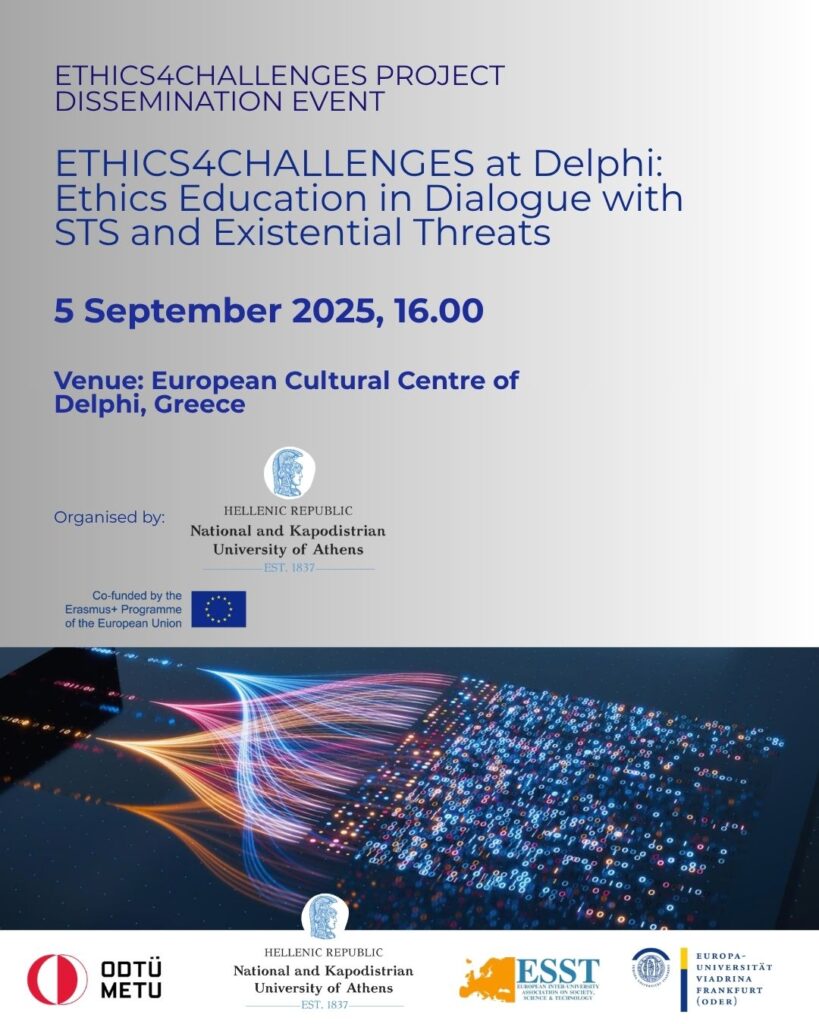
On 5 September 2025, the ETHICS4CHALLENGES project contributed to the EASST-supported workshop titled “Emblematic localities against existential threats: STSing Balkans, Balkanizing STS,” held at the European Cultural Centre of Delphi, Greece, in the framework of the EU COST Action DATAMIG (find out more information here.).
The workshop formed part of a broader discussion on sociotechnical challenges related to migration, artificial intelligence, and large-scale data systems. Within this context, ETHICS4CHALLENGES engaged directly with ongoing debates in Science and Technology Studies, focusing on how ethics education can respond to complex and situated technological challenges.
The project was presented by Halil Turan, Gülizar Karahan Balya, and Busra Akkokler Karatekeli. Their presentation introduced the core objectives and results of ETHICS4CHALLENGES, with a focus on the development of flexible ethics education pathways and the role of the Online Educational Platform as a tool for both academic and non-academic audiences.
A key point of the presentation was the connection between ethics education and real-world challenges. The project approaches ethics not as an abstract field but as a practice grounded in specific contexts. The emphasis on modular learning pathways allows educators and professionals to adapt ethical reflection to different disciplines, institutional settings, and local conditions.
The workshop created a space where this approach could be discussed alongside other research projects. The presentation by the HFRI-funded project on anthropogenic risks highlighted the importance of organizational preparedness and local-level coordination in addressing environmental and societal threats. This created a productive dialogue between different approaches to risk, responsibility, and governance.
The broader theme of the session, “STSing Balkans, Balkanizing STS,” encouraged reflection on how knowledge production is shaped by regional contexts. Discussions focused on how local experiences of crisis, infrastructure, and governance can inform broader theoretical frameworks. Within this setting, ETHICS4CHALLENGES contributed a perspective centered on education, showing how ethical awareness can be developed through structured, accessible, and context-sensitive learning processes.
The discussion that followed the presentations brought together participants from different countries and disciplines. Contributions addressed the role of ethics in AI, environmental crises, and migration systems. Participants reflected on how ethical challenges are experienced differently across contexts and how education can support more informed and responsible responses.
Participation in this workshop strengthened the connection between ETHICS4CHALLENGES and the wider STS community. It also reinforced the relevance of the project’s approach, especially the focus on flexibility, interdisciplinarity, and real-world applicability.
The Delphi setting, with its historical association with knowledge and reflection, provided a strong backdrop for these discussions. The exchange of ideas during the workshop highlighted the importance of connecting ethics education with ongoing research on technological and societal transformations.
ETHICS4CHALLENGES will continue to engage with academic and non-academic communities through similar events, contributing to the development of ethics education that responds to contemporary challenges in a concrete and actionable way.